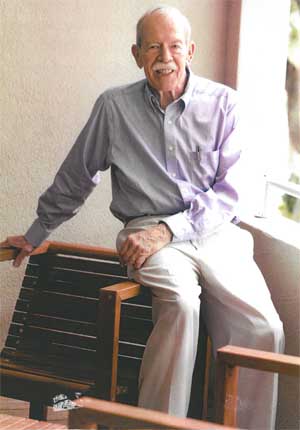
William Newton Morgan, 85, of Atlantic Beach passed away after a long illness on January 18, 2016. Mr. Morgan was a distinguished architect, historian, author and scholar. He was born on December 14, 1930 in St. Vincent’s Hospital, in Jacksonville, Florida. He attended Fletcher High School and graduated in 1948 and entered Harvard College after successfully winning a competitive national NROTC scholarship.
He served aboard the USS Missouri as a Mid-Shipman after which he returned to Harvard to study architecture and graduated in June 1952, magna cum laude. With the Navy he was commissioned as an Ensign on the USS Bausell, later ascending to the rank of Lieutenant-Commander. After 40 months at sea during the Korean War, he was transferred to the island of Guam where he met and married his wife, Bunny. Returning to Cambridge he entered the Harvard Graduate School of Design to earn his Master’s Degree in Architecture.
At Harvard, he was influenced by many contemporary scholars such as Walter Gropius, Eduard Sekler, Jose Sert and Paul Rudolph, which lead to the development of his own style. He later became a Lehman Fellow and received a Fulbright Grant, which allowed him to study abroad in Rome.
Early in his professional career, William became interested in using earth as a building material. He began to study earth structures built by Native Americans centuries before Europeans arrived in the New World. Collaborating with Ludwig Glaeser and with help from the University of Texas, University of Florida and MIT, William published many books on the subject, including Earth Architecture, Prehistoric Architecture in the Eastern United States, Ancient Architecture of the Southwest, and Pre-Columbian Architecture in Eastern North America.
His long architectural career included many innovative designs such as his residences in Atlantic Beach, the Dunehouse, the Jacksonville Children’s Museum (MOSH), and Baptist Pavilion. He also designed the Florida State Museum in Gainesville, Federal Courthouse in Fort Lauderdale, and the U.S. Embassy in Khartoum, Sudan, receiving numerous design awards and national recognition.
William was elected to the College of Fellows in 1974, became the chairman of the AIA Committee on Design and was a visiting architectural critic and lecturer at Tulane University, University of Florida, the Harvard GSD, NC State, Florida A&M, and Auburn. He was a Distinguished Professor of Architectural Preservation, for the University of Florida architecture students.
The AIA Florida Caribbean Region awarded William Morgan Architects the 2000 Millennium Award of Honor for Design as One of Florida’s Top Three Design Firms of the Twentieth Century. In 1998 the American Institute of Architects bestowed an Institute Honor on William in recognition of his lifelong research in to the beginnings of architectural creativity. In 2013 he received the Lifetime Achievement Award from University of Florida School of Architecture. The Florida AIA’s 100th year celebration of a hundred buildings included three of William’s buildings.
His most distinguished professional recognition was the Doctor of Arts conferred by the University of Florida in 2013, in recognition of the scope and impact of his architectural work as well as his contributions as a scholar of architecture and archaeology. His archival collection may be viewed in the University of Florida George A. Smathers Architectural Library.
William is survived by his wife of 61 years, Bernice Morgan, his son William Newton Morgan, (wife Jenny Morgan) of Poulsbo, Washington, his son Dylan Morgan (wife Clicker Morgan) of Atlantic Beach, his grandchildren, Lucy Ruth Morgan, William Seton Morgan, Mary Giles Morgan, Naomi Louise Morgan and Willa Ruth Morgan.
A Celebration of Life will be held on Saturday, February 27th at 2pm at Beach Church (Beach United Methodist Church), 325 7th Ave. N., Jacksonville Beach.
June 9, 2026