
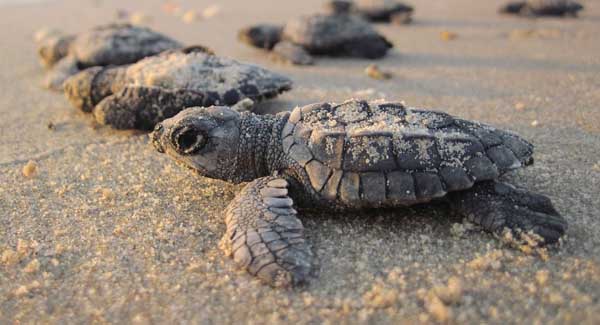
Temporary beach closures could benefit the upcoming sea turtle nesting season, according to local turtle experts. Sea turtle nesting season officially begins tomorrow, and the empty beaches closed to the public to limit the spread of COVID-19 gave turtles the opportunity to come ashore and place their eggs without distraction or interruption.
“It stands to reason that when the human presence isn’t on the beach, that it’s a better environment for the turtles,” said Jennifer Burns, executive director of the Beaches Sea Turtle Patrol. “With the beaches being closed now at night, that definitely bodes better for the turtles than if they were open but, we can’t really point to any evidence that anything has changed because they’re not here yet.”
According to Burns, they usually don’t see any evidence of crawl activity until mid-May. But less beach activity means a higher likelihood of a successful nesting season. Discarded beach items like chairs, canopies and sand toys can become obstacles that block nesting and can lead to false crawls.
A false crawl occurs when the female turtles emerges from the water to unfavorable nesting conditions with human debris left behind on the beach or is disoriented by bright lights, she may return to the water without laying any eggs.
According to Beaches Sea Turtle Patrol, a total of 89 loggerhead false crawls were recorded during last year. The 2019 season was a record-breaking year with a final 2019 nest count of 114 loggerhead nests, two green nests and zero leatherback nests. A total of 96 nests were evaluated, with 7,629 eggs hatched and 2,353 unhatched eggs counted. Volunteers also counted 13 unproductive nests, 11 nests that were completely or partially washed out, and 15 listed as status unknown.
The average number of eggs in a clutch – the term used to define a batch of nesting eggs – for loggerhead turtles is 110, but they can range from the double digits to the highest number of 178 recorded in a single nest in 2019.
Beach goers should also fill in any holes dug in the sand that may cause a nest to collapse and suffocate the eggs. Burns said the turtles have a strategy to increase the probability of successful incubation. Each turtle deposits multiple nests throughout the season at different places.
The Florida Fish and Wildlife Conservation Commission asks beachfront property owners and beach visitors to help nesting turtles and hatchlings by turning off any lights that are visible from the beach at night and may cause sea turtles to get disoriented. Buildings and other structures along the beach that need lights for human safety can be lit with long wavelength amber LED bulbs in a downward-directed, well-shielded fixture that is not visible from the beach.
“Hopefully, the beach will stay cleaner. It will stay darker and there won’t be things left out over night,” said Burns. “None of those things should happen anyway, whether people are down on the beach or not.”
Sea turtles could benefit from beach closures
By
Liza Mitchell, Contributor